Four Steps in the Process of Fashion Change.

This week we took it to one of the garment factories to find out how a slice of clothing is made and what sort of piece of work is put into making your dream design come true. With simply a set up of newspaper patterns and a couple of meters of fabric, we visited a big clothing manufacturer from Northern Europe with a goal to proceeds a full understanding of the process. Let u.s. share it with you:
Without prior knowledge of how the garment manufacturing industry works it can be a bit confusing. People working with clothing factories for the beginning time are frequently frustrated with delays, long lead-times or with the lack of flexibility from the factory when a brand requests concluding-minute changes. You can too cheque out our guide on working with wear manufacturers.
Seeing the process of apparel production will help you to understand information technology and set your expectations right. This volition permit you lot to build a better relationship with the clothing manufacturers. On this topic you can check out our blog post on how to talk to vesture manufacturers when you lot institute that right one.
Every pattern starts with a sketch, then a tech pack or CAD cartoon. Luckily, we already completed our pre-production steps working with a lovely Designer and Tech Pack maker who sorted all this for us, helping transform an idea nosotros had, to a very specifically looking technical drawing and a spec sheet. We then took the CADs to a Pattern Maker we knew and had patterns cutting for the states. We brought these to the manufacturer…
one. Patterns – Paper vs Digital
The clothing manufacturer noted straight away that for sampling and proper product our paper patterns would have to exist digitised as some things are impossible to do by having only paper patterns. In the modern digital globe having sewing patterns in a file rather than on paper simply makes sense. The manufacturer's pattern making specialist took our paper patterns and placed them on a large lath, which is called the digitiser. It immune the pattern maker to input the paper patterns into their own system, in our case the factory used the Assyst software. Each blueprint part was paced around with a manus-held device that took a snapshot of the position of the pattern for each dot. They went all effectually the pattern piece until all information was collected and our design appeared in their software. This is a fourth dimension-consuming process, equally some garments take tens of panels. We were lucky as we only had a few.


2. Sorting out the patterns after digitising
The blueprint maker noticed there were a couple of crude places and little imperfections which could be easily adjusted and fixed now that the pattern was in their organisation. Working with digital patterns allows the pattern maker to brand alterations and changes with surgical precision. All measurement adjustments are visualised and tracked in real fourth dimension. By the way, the same fix of patterns would exist used later to form to other sizes if we approved the produced samples. Size grading is washed using the same software.


three. Lay-plan: Getting patterns ready for production
The next step was to impress out the patterns on a plotter. To do and so the factory specialist had to prepare a proper lay-program, which meant laying out all design blocks in a specific lodge (in our case sampling) taking into consideration things such as cloth length, roll width, the total number of items to be produced with a breakup of sizes. As patterns were now in their system information technology was quickly done. The software used for the lay-plan then suggested the optimal layout of these geometrical shapes (patterns) for the quantities we had and other criteria to make the best use of the fabric and reduce fabric consumption. Although the software did this pretty well, at that place still was room for improvement.


A skilful specialist like the one we had could recognise this and ameliorate the layout suggested by the professional software. The layout was moved around until the manufactory specialist knew the layout was absolutely perfect. We were told that an optimal fabric use efficiency is around lxx-80%. With a higher variation of sizes and higher amounts of smaller design part details in production, the efficiency will e'er be higher.
Note that fabric consumption for a sample and for majority product for the aforementioned item tin can profoundly differ. Call up of the good one-time Tetris, you are stacking shapes trying to avert blanks and empty spaces.
4. Cutting the material
The plotter printed out our patterns from the pre-compiled lay-plan and workers were fix to cut our fabric. Patterns were printed on the special paper that stuck to the fabric seamlessly, then when the cut was washed nada would slide. As the cut began we noticed that the initial function was done manually with the pair of scissors, but and then the finer $.25 were trimmed with specialised equipment.

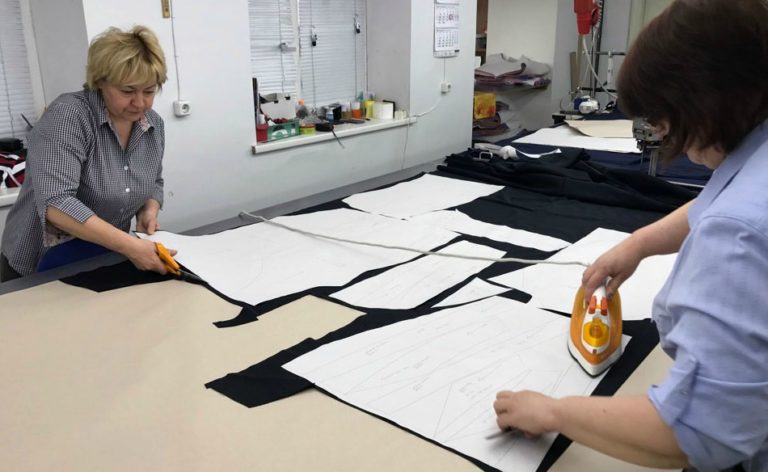
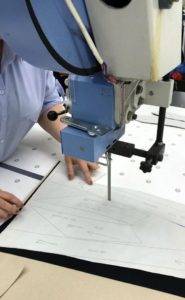
We were told that samples are frequently cutting manually, whereas for bulk production the process is slightly unlike. The same types of material articles are layered on superlative of each other like a cake and cutting in bulk. The garment manufacturer told us that composition and thickness of the fabric determines if it can be cut together. For instance, cotton and viscose cannot exist cutting at the same time. Different fabrics react differently to cutting and can distort more than others, so the effect will be uneven. This is why fifty-fifty if at that place is a ane% difference in limerick a separate cutting job is needed. Looking effectually we noticed a lot of layered textile already cut and prepare to go. Well, back to our samples…
5. Making sets for the seamstresses
Once the cutting was completed all cut pieces were put together in sets. To optimise production similar operations were grouped and so people could pick upwardly speed doing the same thing over and over gradually saving fourth dimension on production. Think of the way you castor your teeth every unmarried day. By now you probably have a technique that made you more than efficient at it.


6. Colours and Trims
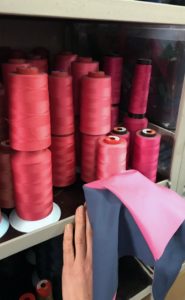
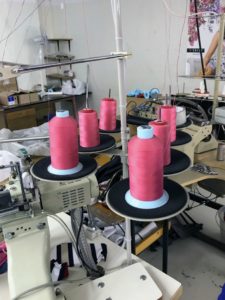
For production stage we were asked to select the correct colour of the threads to match the color of the material. With a little attempt we managed to find the best matching colours. Nosotros were faced with a lot of options. Some had minimal differences and nosotros have not even seen all the bachelor shades.
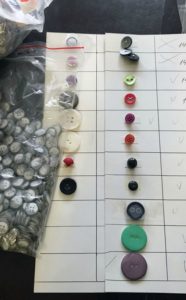
Trims were non required for these items except for elastics but we noticed a large pick of zips, buttons and other accessories offered past the fabric.

7. Adjusting the machinery
Our specialist had her set of cut material pieces and was set to commencement sampling only she had to adjust the equipment first. Every sewing machine has to be adjusted for a specific type of material. She began unloading the old threads and putting in the new reels for our samples in the colour nosotros chose. The seamstress took 6 reels of threads of the same color equally our garment and placed them in the flat-lock sewing machine. She so tested the seam on a slice of cloth to be sure the tension was set and adjusted properly.

viii. Finally, Sewing
Checking that everything was adapted properly she began laying out the set and sewing together the pieces until we started to run into our pattern finally coming to life. It was a truly exciting moment!


9. Finishing
Once the items were completed she took them to the sampling unit to check the measurements against our spec. Everything looked fine and after some thorough QC we tried on the samples, approved them for grading and went on to talk over the futurity bulk production order.
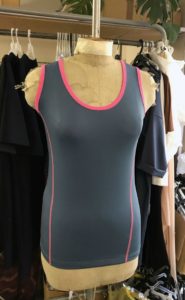
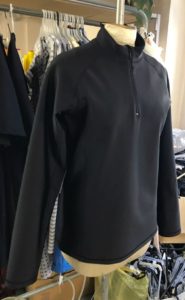
All in all, the whole process took us half a day. Practice take into consideration that we were given dedicated people and sampling was reserved for u.s.a. for the whole twenty-four hour period. The team that nosotros had contact with during the sampling stage was around 5-6 people and our sample went through v (!) different departments from blueprint making, plotter layout specialists, components and trims to sampling and finally to quality control.
After we saw the enormous work that was done, we understood that every bit much every bit we wanted to rush things with a factory, it merely cannot exist done in one hour. It requires preparation, adjustments and work of a dedicated squad.
Clothing manufacturers rarely share this information or allow people spend a day with them to find the process. We felt we gained a much deeper understanding of the work they do and we are excited to share this information with you. I hope this article will be helpful to all those working with factories or only starting off to understand the product stages of sampling and capeesh that is it a precise and complex process, not a 1 minute task. If you are set for product bank check our out guide on 10 mistakes to avoid when dealing with wear manufacturers and get the ball rolling.
0 Response to "Four Steps in the Process of Fashion Change."
Post a Comment